In this article, I explore how curiosity becomes quietened, why turning it towards ourselves can feel threatening, and how its return may bring greater understanding and more choice in how we live.
How our environment can silence curiosity, why looking inward may feel threatening, and what becomes possible when our questions return
We arrive curious
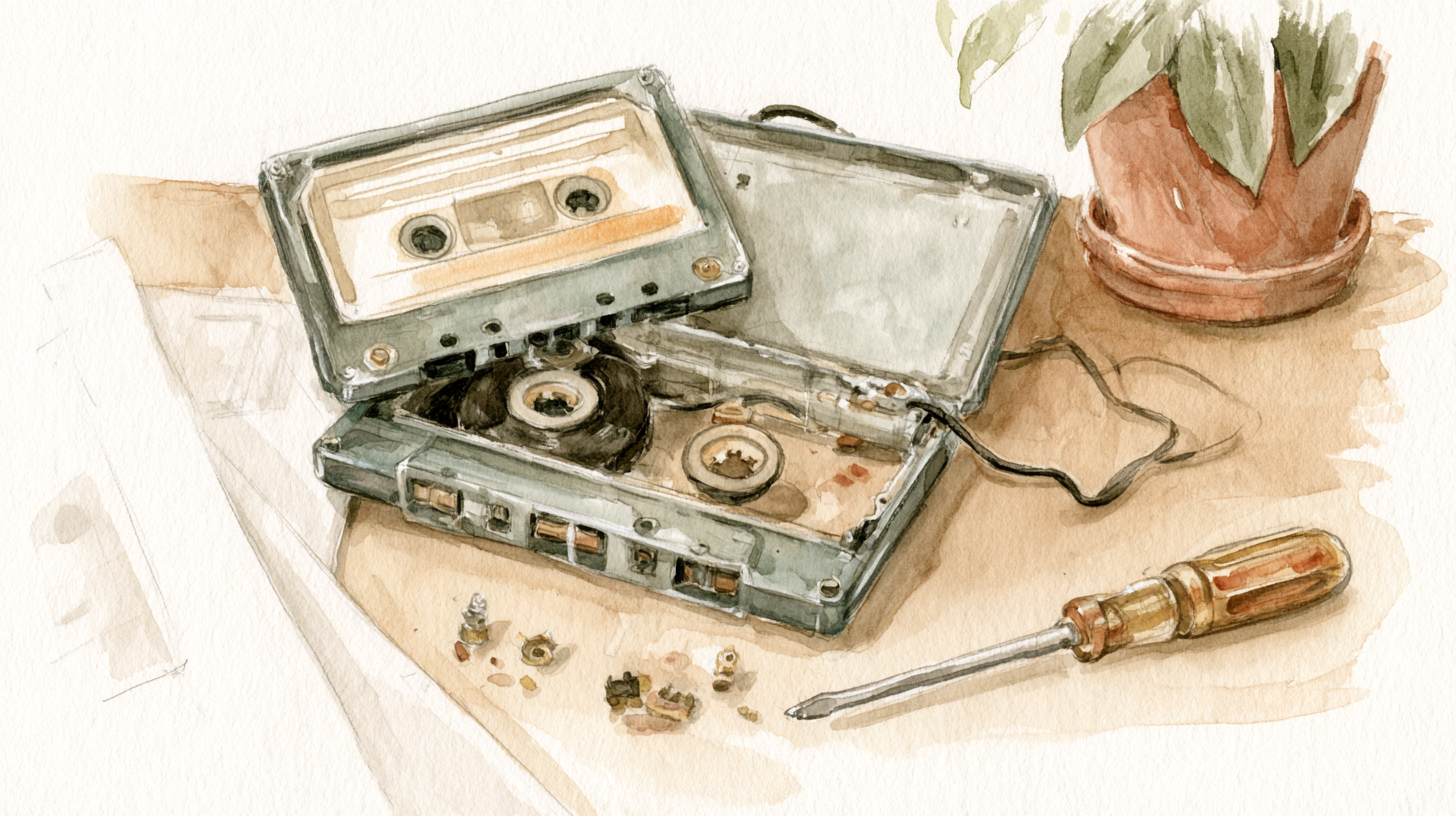
My mum tells a story still to this day, of a young boy aged four or five, who was so curious about how his tape machine worked (yes, cassette tapes, for those who remember them?!) that he grabbed some screwdrivers and took it completely apart. Yes, that was me, and she discovered me with this tape machine in pieces, clueless how to put it back together but, now with a better understanding of how it worked and deeply satisfied as a result!
By all accounts I had an insatiable curiosity about pretty much everything and this seems to be quite common with children. It is as if we are born with this curiosity to understand our world, people, things....everything! We arrive in the world curious and as self-awareness develops through childhood and into early adulthood, that curiosity naturally begins to extend inward. We don't just ask how the tape machine works. Eventually we start asking bigger questions such as who we are, what we feel, why we respond the way we do. For each of us, curiosity, in our own timing and given the chance, turns inward as well as outward.
So why does it so often seem to stop?
How we learn where curiosity is welcome
Susan Engel, a developmental psychologist who has spent years studying curiosity in classrooms, found something striking. Observable episodes of curious behaviour, for example questions, investigation, sustained attention, occurred around five times more frequently in kindergarten children than in fifth-graders in the USA. By early primary school, expressed curiosity had dropped dramatically.
It's worth being clear what we mean by expressed curiosity as the distinction matters. Expressed curiosity is observable: questions being asked, answers actively sought out. So what Engel could observe was expressed curiosity reducing, as opposed to a change in the underlying desire to know. Whether children retained their questions internally, the silence being suppression rather than loss, is something her research cannot tell us. We will come back to this point a little later in the article.
So why the change? I believe it is because we learn where curiosity is welcome and where it isn't, and our behaviour adapts accordingly.
Some of us as children may have been told explicitly to stop asking questions, the message being 'a knowledgeable adult has shown you the right way to do this, so there is nothing else worth discovering'. For others the instruction is far more subtle, the message arriving through smaller things: the teacher who keeps moving when a child wanders off-topic, the adult who gives a perfunctory answer and changes the subject, the slow accumulation of moments where curiosity met indifference or inconvenience.
Psychological safety research with adults shows the same mechanism operating decades later: where questions risk embarrassment or career consequences, silence makes complete sense. If we have already learned in childhood that questions carry a cost, it seems reasonable that we may be even quicker to silence ourselves when similar risks appear later in life.
The implicit lesson arrives early in our lives and remains: there is a right path through this task, and your curiosity is slowing us down or simply unnecessary.
When curiosity begins to feel threatening: "No, not again"
Now, I'd like to come back to the earlier question left unanswered: Is it just expressed, externally recognised curiosity that is lost, or might it also be lost inwardly? Do we just stop asking people or over time, might we also perhaps stop asking ourselves?
Something I have come to believe both from my own experience and from my work with clients, is that the external quietening doesn't always just stay external. The suppression of curiosity moves inward too.
Here is why I think this happens. When our questions, ideas and wonderings have repeatedly been met with dismissal, shame or simply nothing, those experiences can continue to influence us without returning as conscious memories. Psychologists use the term implicit memory to describe how previous learning can shape what we expect and how we respond, even when we are not deliberately recalling what happened. We may not remember every occasion when our curiosity was unwelcome, yet still anticipate the frustration of being dismissed, the shame of asking the wrong question or the discomfort of finding nobody willing to meet us. Before we have consciously decided whether to look, something in us may already be pulling back, quietly saying, "No, not again." We can often feel this in our bodies as the nervous system responds to a perceived threat, sometimes before we can put the experience into words.
We are dealing with two things at once. Not only does looking trigger the emotional memory of past dismissal, but there is an additional belief running underneath: even if I look, what I find probably isn't worth much anyway.
Eventually, as an act of self-preservation, we may learn not to go there at all. Not because the questions do not matter, but because asking them has hurt too often.
Why curiosity about ourselves can feel threatening
So what is it that keeps us from going back and getting curious about ourselves again?
I think there are actually two distinct but related fears at work here, and it's worth naming both.
The first builds directly on what I described in the last section. Once curiosity has been repeatedly met with dismissal or shame, the very act of trying to be curious can feel threatening, because we have learned to anticipate what that feels like. The emotional memory activates before we have even asked the question. There is a fear of the process itself, a fear of what it will feel like to look, that can stop us before we have even started.
But there is also a second fear, and in some ways this one is more fundamental. It is the fear of what we might actually find.
Fear that if we ask 'what do I really want?' the answer might be something we cannot act on. Something that would require enormous change, would hurt people we love, would mean dismantling a life that others depend on. It can feel safer not to know. I also encounter many people who have tried asking themselves this question and find that they don't know the answer. They don't know themselves. Maybe they have followed the path through their lives they believed held the least resistance or pain. This isn't at all uncommon, especially for those whose questions or needs were repeatedly shamed or dismissed. However, facing ourselves honestly and not recognising what is reflected back can be very scary.
Fear that asking 'why am I like this?' might confirm the worst thing we already suspect about ourselves. That there is something fundamentally broken or unlovable at the core. As long as we don't look too closely, we can maintain some uncertainty about that. Looking risks removing the uncertainty in the wrong direction.
Fear that genuine self-inquiry will open something we cannot easily close again. That we will find not an answer but a depth of pain, grief or longing that we won't know what to do with.
And perhaps most practically, fear of the implications. If we get curious about our own experience and find that a relationship isn't right for us, or a career has been wrong, or we have been living according to someone else's template rather than our own, then we have the challenge of then doing something with that knowledge. Staying incurious has been a way of staying safe.
I don't think these fears are irrational. In fact they make complete sense given what many of us have learned. But they do keep us stuck. Stefaan van Hooydonk, founder of the Global Curiosity Institute, identifies self-reflective curiosity as the hardest of three types, and the reason he gives is simple: we have two eyes to watch the world but none to watch ourselves.
How fixed stories replace curiosity
We do not only learn to stop asking questions. We also become very quick at supplying answers. 'Why am I like this?' becomes 'because I'm broken' before we've even looked. 'Why do I keep doing this?' becomes 'because there's something fundamentally wrong with me' before we've allowed any other interpretation. This is confirmation bias; the brain's tendency to search for evidence that supports what it already believes. Once we have settled on a story about who we are, we become less likely to notice evidence that might tell a different one.
Curiosity is what keeps us looking. Not self-criticism. Not analysis. Genuine interest in what is actually going on, whether with others or with ourselves.
How curiosity returned for me
I know something about this from the inside.
For most of my adult life I would have described myself as a curious person and in many ways I was; curious about ideas, about how things work, about people in an abstract kind of way. But genuinely curious about myself? My own patterns, my own needs, my own experience? Not really. Not safely anyway. Adverse childhood experiences had left me numb, disconnected from myself and following a path prescribed by others.
What changed this for me was my own personal therapy and four years of therapy training. Nearly 750 hours learning alongside people whose histories, experiences and ways of seeing the world were often very different from mine. I was confronted, sometimes quite directly, with the assumptions and biases I had been carrying around without even realising they were there. I learned that what I had always assumed to be objective truth was, almost always, my personal truth; built from my own history and experiences and my own particular way of making sense of the world.
But perhaps more importantly, I discovered something I hadn't expected. I could be disagreed with, genuinely challenged, and still be accepted as a person.
For someone who had spent fifty-odd years believing that belonging required agreement; that any challenge to what I said or thought meant a rejection of who I was; this was significant. The need to protect and defend softened. And with it, something returned that I think was always there; a curiosity about myself. Something that felt less newly created than rediscovered.
Fear had been blocking it. Not in an obvious way. But in the quiet way that stops you from asking the questions that might actually change things.
What makes curiosity possible in therapy
Many of the people who come to me for therapy have had the experience of being misread or misjudged. Told that their feelings are too much, or not enough. Judged for how they show up. Dismissed by people who were supposed to understand them.
So they arrive, quite understandably, with their guard up. Already explaining and justifying themselves before they have even been asked a question. Already bracing for the response they have learned to expect. Sometimes avoiding the harder inward questions altogether, because the avoidance itself has become a form of protection.
What I have found, both in the therapy room and in my own experience, is that something can begin to shift when you become genuinely curious about yourself in the presence of someone who is also curious about you. Not someone trying to force an interpretation or steer you towards a predetermined conclusion, but someone willing to understand before deciding what your experience means. There is a real difference between being observed and being understood and in that space, some people begin to ask themselves questions they have been avoiding for a long time.
What self-curiosity looks like in practice
This doesn't mean finding answers straight away. Or resolution. Often it is something much quieter than that.
I remember sitting in a coffee shop, doing well on a new diet and feeling motivated to keep going. I sat down to start writing and noticed something. A tightness at the bottom of my ribcage and then a craving for something sweet, something to eat, something to break the feeling.
I recognised that feeling. I have acted on it many times without stopping to think about it.
This time I did not immediately try to make it go away. I paid attention to it. I got curious about it instead of reaching for what would make it stop. As I paid attention, I began to recognise something about fear: what it means to begin, the weight I attach to starting things, and the worry that what I produce will not be good enough.
That is what curiosity about yourself makes possible. Not the absence of the tightness. A different relationship with it. The ability to be interested in your own experience rather than afraid of it.
How our questions can begin to return
Perhaps some of the questions you stopped asking still really matter. Perhaps they have become harder to hear but with the right conditions and encouragement, they can begin to return.
Getting curious again doesn't guarantee that it will be comfortable. It may well bring up some of what it always has; the discomfort, the residue of the times when curiosity wasn't welcome. But there is a difference between the discomfort of genuinely looking and the pain of never looking at all.
Beginning again may require something both simple and difficult: enough willingness to remain interested for a little longer.
One way to begin might be to deliberately encounter perspectives different from your own. This does not require four years of training or hundreds of hours spent in a group. It might mean seeking out people with different experiences, reading an opinion you would normally avoid or listening to someone whose understanding challenges your own. You might begin online, where you can encounter that difference while remaining in familiar surroundings and choose when you have had enough. The intention is not to convince yourself that the other person is right, nor is it to convince them that you are right! The goal is to remain curious about their perspective and to notice what happens within you as you meet it.
As you do this, you might notice what happens in your body. Perhaps there is a tightening, a wish to withdraw, a sense of closing down or a clenching as if preparing for an argument. Somatic therapy approaches understand reactions such as these as possible signs that the nervous system is preparing us for action in response to something it perceives as threatening. You may not notice anything clearly; that doesn't mean that nothing is happening. I certainly did not recognise these signals easily at first. It was only over time that I began to understand that some physical sensations were clues that something was happening before I could explain it in words.
Becoming curious about our reactions to other people can reveal something about the assumptions, fears and experiences we carry within us. Self-curiosity does not guarantee easy answers, but it can loosen the hold of the fixed stories we have learned to tell about ourselves. As we begin to understand more of what shapes our feelings and reactions, we may also find that we have more choice in how we respond and what we do next.
So rather than moving quickly to the next story you tell yourself about why you are the way you are, what if you stayed with the question a little longer? What might you understand differently, and what might become possible as a result?
Sources and further reading
Bonawitz, E., Shafto, P., Gweon, H., Goodman, N. D., Spelke, E. S., and Schulz, L. (2011). The double-edged sword of pedagogy: Instruction limits spontaneous exploration and discovery. Cognition, 120(3), 322--330.
Edmondson, A. C. (1999). Psychological safety and learning behavior in work teams. Administrative Science Quarterly, 44(2), 350--383.
Engel, S. (2011). Children's need to know: Curiosity in schools. Harvard Educational Review, 81(4), 625--645.
Jirout, J. J., Zumbrunn, S., Evans, N. S., and Vitiello, V. E. (2022). Development and testing of the Curiosity in Classrooms framework and coding protocol. Frontiers in Psychology, 13, 875161.
Nickerson, R. S. (1998). Confirmation bias: A ubiquitous phenomenon in many guises. Review of General Psychology, 2(2), 175--220.
Schacter, D. L. (1987). Implicit memory: History and current status. Journal of Experimental Psychology: Learning, Memory, and Cognition, 13(3), 501--518.
Van Hooydonk, S. (2022). The Workplace Curiosity Manifesto: How Curiosity Helps Individuals and Organizations Thrive in Transformational Times. New Degree Press.